
Community food organising guidebook
Practical ideas and resources for people who want to bring others together around food.
Whether you are starting a growing project, food co-op, community event or local campaign, this guide will help you take the first steps, work well together and build something that lasts.
Working together around food
Community organising is about people coming together to make positive change. It can mean starting a project, sharing a meal, growing food, running an event or challenging the things that make good food harder to access.
Why organise? What’s wrong with our food system?
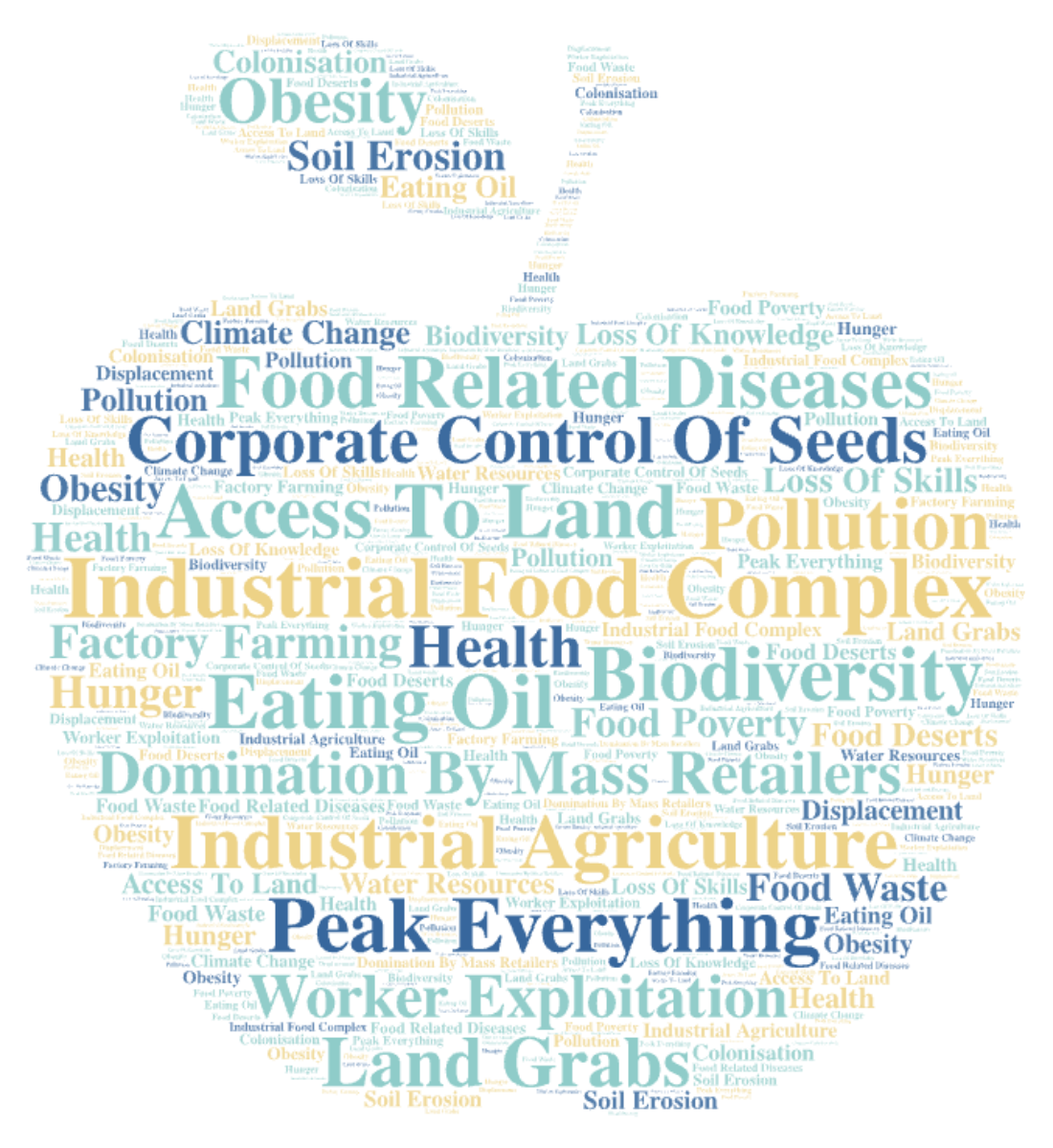
Writing about the harm of our industrial food system would be a book in itself, we’ve listed key points about the current impacts that feeding ourselves is having in the apple.
What is organising
Lee Staples, a well known community organiser from North America, describes community organising as “collective action by community members drawing on the strength of numbers, participatory processes, and indigenous leadership to decrease power disparities and achieve shared goals for social change.”
In short, the most basic goal of grassroots community organising is to bring about social change.
Organising includes many things - like holding meetings, organising events and starting projects. However, it can also include shared meals, collectively growing together in a garden. Anything where you work with other people to change our food system, challenge injustice and create a more ecological way of feeding each other, is community organising.
Through organising and working together we can build power and make change.
Recommended books about Community Organising
Call to action:
We need to prioritise food system change - to feed ourselves and protect the planet!
We need to support people to learn how to grow and use food.
We need to ensure sufficient land is reserved for community food production.
Landowners need to release more land for community growing, redistribution will reduce inequalities.
We need to maximise grassroots community action - if you eat you're in!
We need to support a new generation of growers and farmers to develop skills and build viable livelihoods in food production.
-
This Community Organising Handbook is all about organising together to create an ecologically sustainable and socially just food system in Somerset.
You will find information on how to get started, how to support your group to communicate and make decisions together, as well as practical advice about how to start different projects, from allotments to food coops.
It's up to us to organise and work together with other people in our community to make positive change!
-
When you have a newly formed group of people working together, all sorts of challenges can arise in terms of who decides and does what. Thankfully, many organisers over time have developed tools to support ways of making decisions effectively and democratically.
One tool is consensus decision making. Group 'Seeds for Change' describe Consensus decision making as “A creative and dynamic way of reaching agreement between all members of a group. Instead of simply voting for an item and having the majority of the group getting their way, a group using consensus is committed to finding solutions that everyone actively supports, or at least can live with.”
There are different methods and approaches to making decisions by consensus:There are also some emerging approaches such as Holocracy to support groups to make decisions together.
-
As well as deciding how you will make decisions together, you will also need to work out how you are going to communicate. This means looking at:
Meetings: Where, when and how often you meet? How you will connect in between face to face meetings? Email lists are generally the most common tool, but not everyone may like using email or know how.
Email lists: Google groups is straightforward to set up, but some may feel their security is compromised. Otherwise, there are tools such as riseup.net who offer free email list services to groups working for social change. It's good practice to keep your group closed to keep group conversations confidential.
Websites: Most groups will generally have a website, you have control over content and can keep your messages consistent and aimed locally, or to whoever you want to reach. The amount of hosting providers is huge. You can use a free one such as wordpress.com or you could pay for hosting and your own domain name. (We used squarespace.com to make this website :)
Email address: You will need an email address but we wouldn't recommend using your personal email, as groups change over time. There are many free email accounts online - gmail, rise up, yahoo etc..
Social Media: Many people get their news and engage in campaigns through social media, such as Facebook or X. You can also get tools to use in your website that will automatically update your social media accounts. If there are a lot of people in your group, having a group page may be an easier way to organise than an email list for example.Grassroots publicity & outreach: Unfortunately, we don’t have the budgets of governments and corporations in terms of advertising and targeting of public space. However what we do have is numbers and creativity. Before undertaking any publicity, think it through. Why are you doing this? Who do you want to attract? For what reason?
Knowing your purpose will help you decide your publicity platforms and how to best target your efforts:
• Physical posters & leaflets, word of mouth (don’t underestimate it!), newspapers & magazines, radio, and door-dropping leaflets
• Websites, Social media including Facebook and X, blogging, Email newsletters & discussion lists, independent media sites such as Indymedia
Ask yourself:Is your message clear?
Is essential information obvious?
Is your graphic design attractive?
What does it communicate about you?
How will you manage the potential response generated?
Further information & resources
-
It can be quite challenging in a rural county like Somerset to get things off the ground locally. However, with a bit of long term thinking and different strategies, we can still find allies in rural areas. Key tips:
Tap into existing groups and networks - contact Parish Councils, local charities, the WI and others to find local, connected people with experience in making things happen.
Go to where people are, attend local mother and baby groups, fetes and agricultural fayres to create opportunities to meet people and build relationships. You can also drop leaflets through doors.
Utilise local publicity, such as the very local parish news, local publications or newspapers, mainly read by those that don’t use the internet.
Host visitors! Need some radical energy now and again? Why not host WOOFers or visitors from other projects and places, to keep your group inspired & interesting.
Don’t isolate yourself. Even if it takes energy to travel, get along to inspiring events and actions, and make the effort to organise and spend time with people that you have shared passions with.
Don’t expect miracles. Grassroots community organising is a long term process! Relationships and projects can take time to mature and develop into something abundant.
-
In Somerset, a common query from groups organising for social change, such as transition groups, is how to attract young people. It seems like there is a deficit of youthful energy. However, there are ways to get young people on board, and the tips are similar to the above:
Working with established organisations that have relationships with young people is really important, for example the YMCA in Somerset, Young Somerset.
Be aware that funding and services to young people have been brutally cut in Somerset, we don’t have much formal infrastructure in place to support young people.
Go to where they are - be it schools, colleges, skate parks and so forth.
Understand that a lot of young people will leave Somerset to go to university or to move for employment. Growing up in a rural area can be challenging, its very likely that a lot of young people will leave to spend time in cities, even if they do return a few years later!
Young families are under enormous pressure, to simply survive, get the bills paid & feed their families. Be aware of demands you are placing on each other, and think of how your organising could support someone in this situation so they ‘obtain a yield’. For example the Little Vikings Food Coop in Watchet was started in response to parents struggling to afford to feed their kids fresh veg. Likewise, a gardening club that can help overcome social isolation may be more effective than expecting every family to maintain an entire allotment!
-
There is a common culture in grassroots organising for people to 'burn out' by doing too much for too long in a way that is unsustainable, taking away your energy and enthusiasm for organising. This is caused by a wide diversity of factors and the responsibility lies with not only the person, but the group and culture we create.
“Burnout is defined, and subjectively experienced, as a state of physical, emotional and mental exhaustion caused by long term involvement in situations that are emotionally demanding [with] very high expectations and chronic situational stresses.” (Career Burnout,1998).Even with smaller scale projects, combined with the stresses of life, it is very easy for organising to tip you over the edge in terms of feeling too in-demand and over-committed.
Fortunately, there are a huge number of resources available that can help you see the patterns of burnout and support yourself and others to avoid harming yourself and sustain your organising over the long haul.
-
In working to change our food systems and achieve social change, how we interact with each other is very important.
Does your group tolerate abusive, oppressive or discriminatory language or behaviour?
Are you creating spaces and groups that are inclusive for all forms of diversity including (but not limited to), ability, age, appearance, cultural heritage, education, ethnicity, financial status, gender, health, language, legal status, nationality, personal body choices, race, religion, sex, sexual orientation and gender queer (LGBTQ+), and social class?
The Anti Oppression Resource and Training Collective have some great resources to help you explore your group’s systems and structures and make changes to create an anti-oppression organising culture.
Conflict Resolution
A huge number of groups, if not all of them, will experience conflict when organising together. Our values, ideas and beliefs can clash as well as how we think things should be done.
Turning conflict into a creative solution takes patience and skill but is an essential part of growth. We have tried to collate a few pioneering publications below that can support you and your group overcome and use conflict for positive change in your efforts.
Further information & resources
A short guide to Active Listening produced by Seeds for Change. Active listening is a useful skill for meetings, workshops or dealing with conflict. By actively listening we can understand people and tune into their underlying emotions, concerns and tensions.
This Seeds for Change Working with conflict in our groups booklet is for groups working for social change who want to develop an understanding of conflict and how to deal with it.
Cultivate Co-op - Conflict resolution in Cooperatives
Choose your next step.
DO WE WANT A LITTLE TEXT HERE?
Last reviewed: July 2026
This guide is designed as a starting point. Please check linked organisations and local guidance for the most up-to-date information.